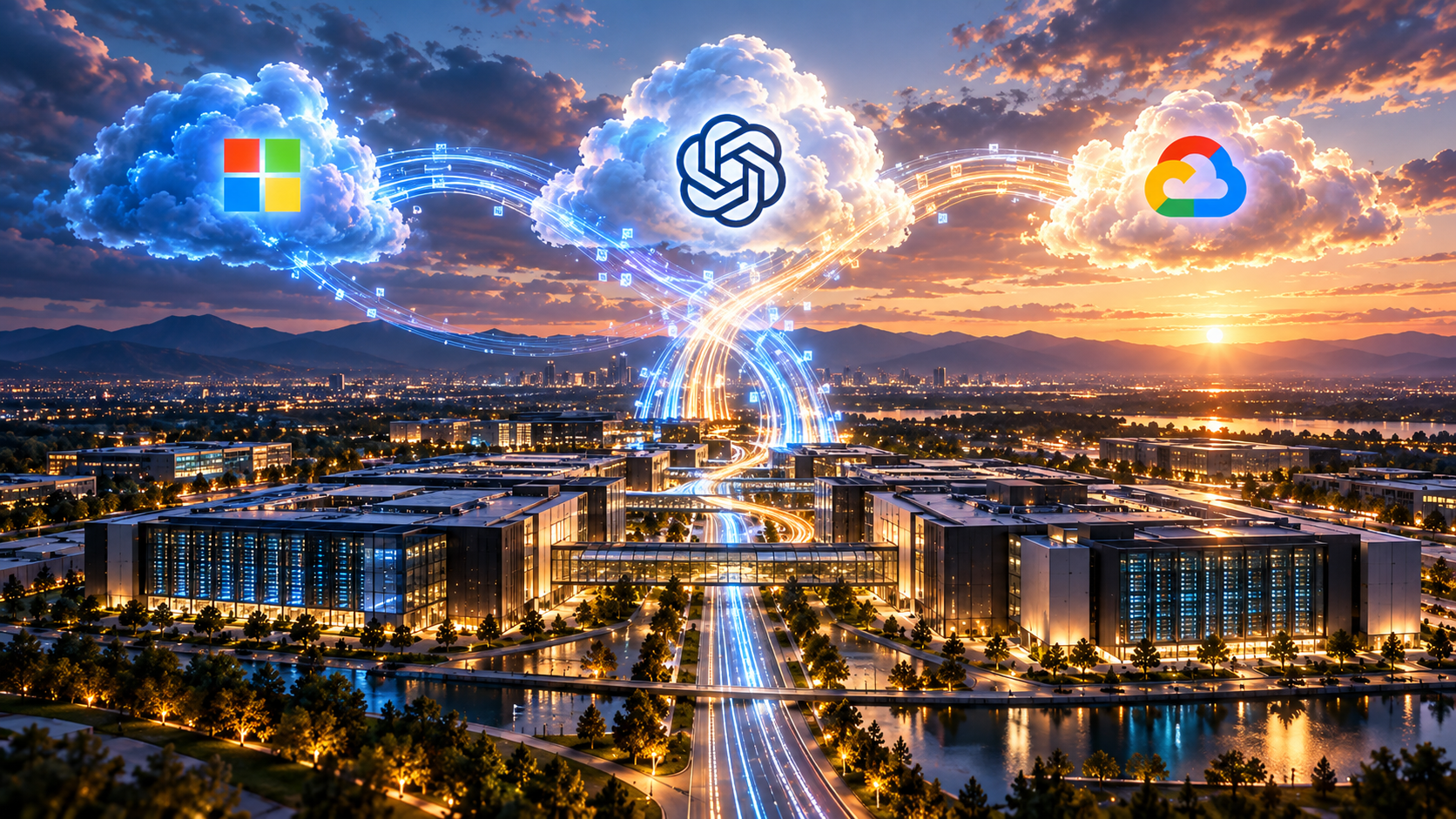
On October 21, 2026, OpenAI and Google Cloud announced plans to bring OpenAI models and Codex workflows to Google's Model Garden. Google competes with OpenAI in AI models, while Microsoft has been a strategic investor since 2019 and remains OpenAI's primary cloud partner. The deal reflects a shifting contest over how enterprise customers access AI.
Why Google would distribute a rival's technology
Google Cloud customers will be able to purchase OpenAI models through Marketplace, including against existing cloud spending commitments [1][2]. Google wants customers to choose models for each workload without abandoning their current infrastructure.
Availability is limited: the offering is in invite-only private preview for approved evaluation and internal tests. General availability is planned rather than already established [1][5].
Does Microsoft lose its position?
Microsoft announced a $1 billion investment and partnership with OpenAI in 2019 [4]. Azure has since been an important enterprise distribution channel, so the Google deal may look like the end of an exclusive relationship.
The April 27, 2026 amendment tells a more nuanced story: Microsoft remains OpenAI's primary cloud partner; OpenAI products generally launch on Azure first subject to stated conditions. OpenAI can distribute through other clouds. Microsoft's model and product IP license is non-exclusive through 2032, and revenue sharing from OpenAI to Microsoft continues through 2030 subject to a cap [3].
Competitors in models, partners in distribution
AI competition spans models, applications, developer tools, computing infrastructure and distribution. Google has Gemini and Google Cloud, Microsoft has Azure and AI-enabled software, and OpenAI seeks broader reach. Firms can compete in one layer while cooperating in another.
The agreement proves no model-performance winner. It highlights demand for procurement simplicity, governance and flexibility as companies integrate AI into real workflows.
More choice does not eliminate lock-in
Access to multiple models through one cloud may reduce integration friction, but it does not make the architecture vendor-neutral. Data rules, identity management, contracts, API compatibility and switching costs remain.
Enterprises should test alternatives on identical tasks, comparing accuracy, latency, price and data controls. Critical systems also need an exit path if a model or delivery channel changes.
Who holds the lasting advantage?
The OpenAI–Google agreement illustrates that distribution and trustworthy operations matter alongside model capability. Microsoft retains a distinctive partnership, Google adds options and OpenAI broadens its reach.
For enterprises, preserving architectural flexibility and negotiating power matters more than guessing which alliance will dominate.
Sources & further reading
- [1]OpenAI models are coming to Google Cloud OpenAI · 2026-10-21
- [2]Google Cloud brings OpenAI models to customers Google Cloud · 2026-10-21
- [3]The next phase of the Microsoft OpenAI partnership OpenAI · 2026-04-27
- [4]Microsoft invests in and partners with OpenAI OpenAI · 2019-07-22
- [5]Private preview eligibility OpenAI · 2026-10-22