
On October 21, 2026, Japan's Digital Agency highlighted Harunobu, an open-source utility for evaluating how easily machines can process Excel, CSV and TSV files. It applies published rules, scores compliance and identifies problematic locations. The announcement speaks to an everyday obstacle in digital transformation: a spreadsheet designed to look clear on a printed page may still require substantial manual preparation before software or AI can work with it reliably. [1][2]
A spreadsheet can be clear to people but ambiguous to machines
Businesses often shape spreadsheets for reading and printing. Merged headers, implied values and color-coded categories help colleagues understand a report at a glance. Yet an automated importer may see blank cells, inconsistent structures or information that exists only in formatting.
Take a sales table that merges a branch name across several rows. A human naturally associates every figure below with that branch, while a parser may receive missing values. Additional transformation logic or manual editing becomes necessary before aggregation.
The problem is not Excel itself. A layout optimized for presentation serves a different purpose from a structured data format designed to move between systems. Japan's Digital Agency describes extreme print-first practices as the 'Kami Excel' problem. [2]
Three levels of machine readability
Harunobu draws on rules for machine readability of administrative data adopted on March 31, 2026. Level 1 targets basic machine viewing and transcription; Level 2 supports aggregation and analysis; Level 3 addresses linking datasets and automating analytical workflows. [2]
Basic checks consider issues such as merged cells, multiple tables in one sheet, spaces used purely for layout and violations of one-value-per-cell structures. More advanced requirements help data fields behave consistently across files.
The software reports compliance scores out of 100 for implemented checks, together with violation locations and reasons. A good score reflects alignment with those rules. It is not a certificate that every business figure in the file is accurate or suitable for every AI application. [1]
What Harunobu does—and what it does not
Harunobu is available through a Streamlit interface, a command-line tool and a Python API. Users can inspect one workbook, schedule checks for many files or integrate validation into an existing data pipeline. Machine-readable results can be exported for downstream processing. [1][3]
Its main function is rules-based inspection and feedback. It does not, on its own, automatically classify every messy workbook, repair all errors and deliver a verified, unified database. A business could add rule-based or AI-assisted cleanup, human review, approval and ingestion around Harunobu, but those are additional workflow components.
Complex layouts and multi-level headers can also defeat automatic table recognition. Some requirements are not checked programmatically. Reviewers still need to consider context and investigate suspicious results. [2][3]
Local validation and external AI are different security choices
Harunobu can run locally. Unless optional external AI assistance is enabled, the rules engine can inspect files without sending their contents to an outside AI service. That makes the default approach relevant for internal, unpublished or potentially sensitive documents. [1]
If a user explicitly enables support through a provider API such as Gemini, ChatGPT or Claude, data may be transmitted to the configured external service. Organizations should check data-handling policies before using that option. Local availability should not be confused with a guarantee that every configuration stays offline. [1]
Designing a supervised standardization pipeline
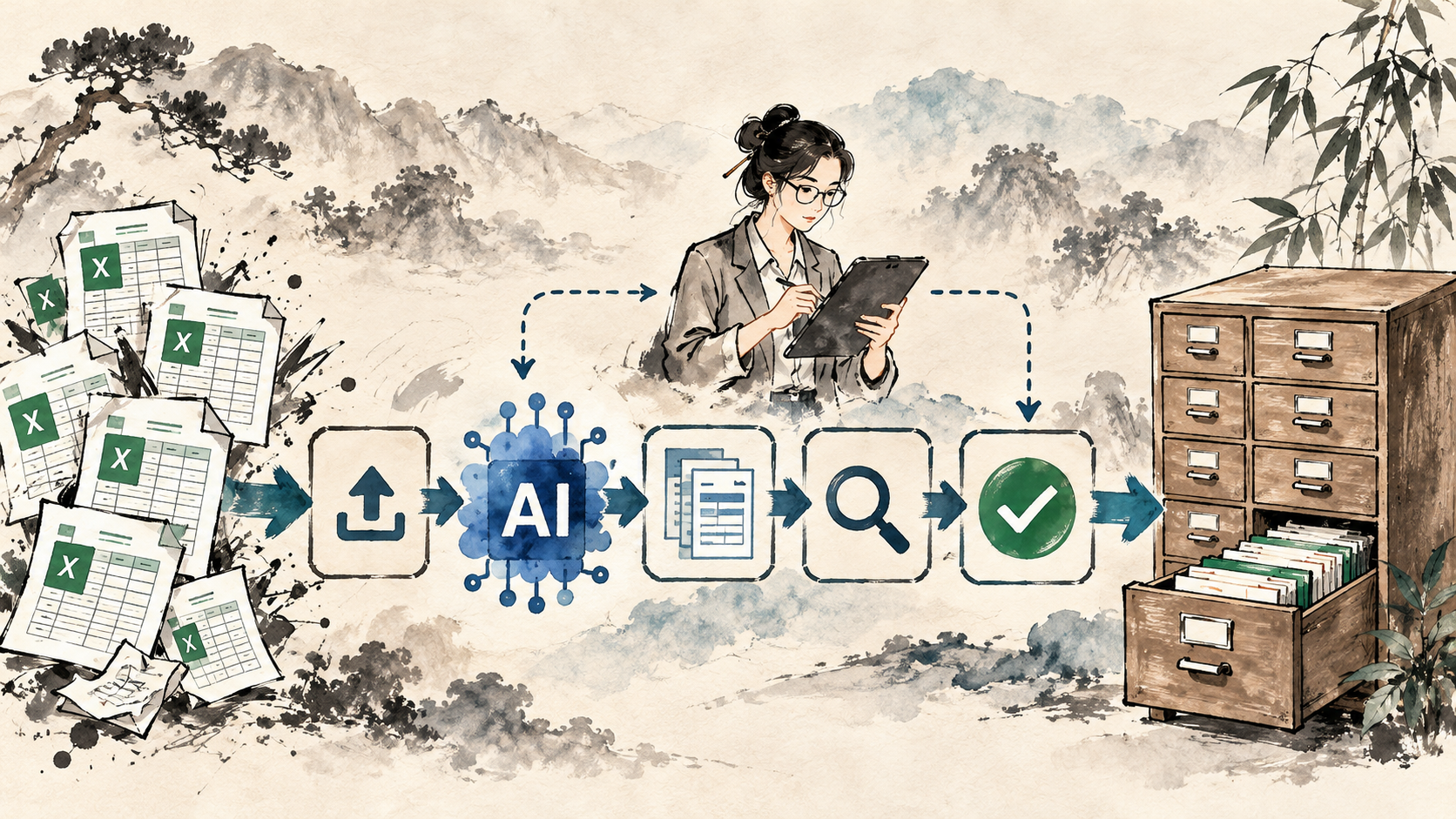
An enterprise workflow could receive spreadsheets from multiple departments, run Harunobu to spot structural issues, classify exceptions, propose corrections using rules or AI, and have an employee verify the output before approved data enters a shared repository. Human review is not a decorative step: it is where business meaning and source-of-truth decisions are confirmed.
A retailer, for example, might use repeated validation results to improve inventory templates sent by stores. Differences in dates, measurement units or merged headers can then be corrected closer to their source, reducing preparation effort in monthly reporting.
Success should be measured by time saved in preparation, fewer import errors, lower rework and the effort required for oversight—not by maximizing a single scoring metric.
Reusable data is a practical foundation for DX
The underlying rules were designed primarily for administrative open data, so private companies should adopt the principles relevant to their own processes rather than treating every criterion as mandatory. [1][2]
New AI capabilities attract attention, but poor input structures create a recurring tax on analytics and automation. Harunobu is valuable because it turns 'data quality' from a vague aspiration into concrete defects that can be located, explained and prioritized.
Digital transformation does not require abandoning spreadsheets. It requires making the information inside them consistent enough to be reused, under a validation and approval process the organization can actually control.
Sources & further reading
- [1]機械可読性ルール適合チェックツール「Harunobu」 デジタル庁 / Digital Agency · 2026-10-21
- [2]Excelの機械可読性を判定するツール「Harunobu」のご紹介 デジタル庁(公式note) · 2026-10-21
- [3]Machine-readability rules and Harunobu open-source project Digital Agency / GitHub · 2026-10-23 (accessed)