We are living through one of the craziest moments in software history. Security tools move from open to closed. Console protections are challenged. Experimental drivers cross old platform boundaries. AI agents reconstruct programs without seeing their original source. A new generation of tiny teams attempts products that used to require entire organizations. These stories aren't identical—and none proves that intellectual property has vanished. Together, they suggest something bigger: the once-sharp distinction between having source code and having only a working program may be becoming less useful.
1. The headlines are getting stranger
Consider six stories that emerged around October 2026. A security testing tool called ARTEX was reportedly used in attacks targeting South Korean financial organizations. Its developer subsequently said the tool would become closed-source and receive no further public updates [1]. The irony is difficult to miss: an open-source defensive tool became entangled in an offensive campaign and moved toward closure.
In the gaming world, a PS5 jailbreak affecting firmware 7.00 through 13.60 made headlines [2]. Separately, an experimental, unofficial driver was reported to enable an NVIDIA RTX 5060 to accelerate Metal workloads on selected macOS 15 Hackintosh setups [3]. Neither example means the platform is permanently or universally open; both demonstrate how assumptions about hardware and software boundaries are continually tested.
- ARTEX: the tension between openness, security research and misuse.
- PS5: a reminder that closed consumer platforms face ongoing technical scrutiny.
- RTX 5060 + macOS: a creative compatibility experiment—not an officially supported driver or a mainstream recommendation.
2. The more radical change is source reconstruction
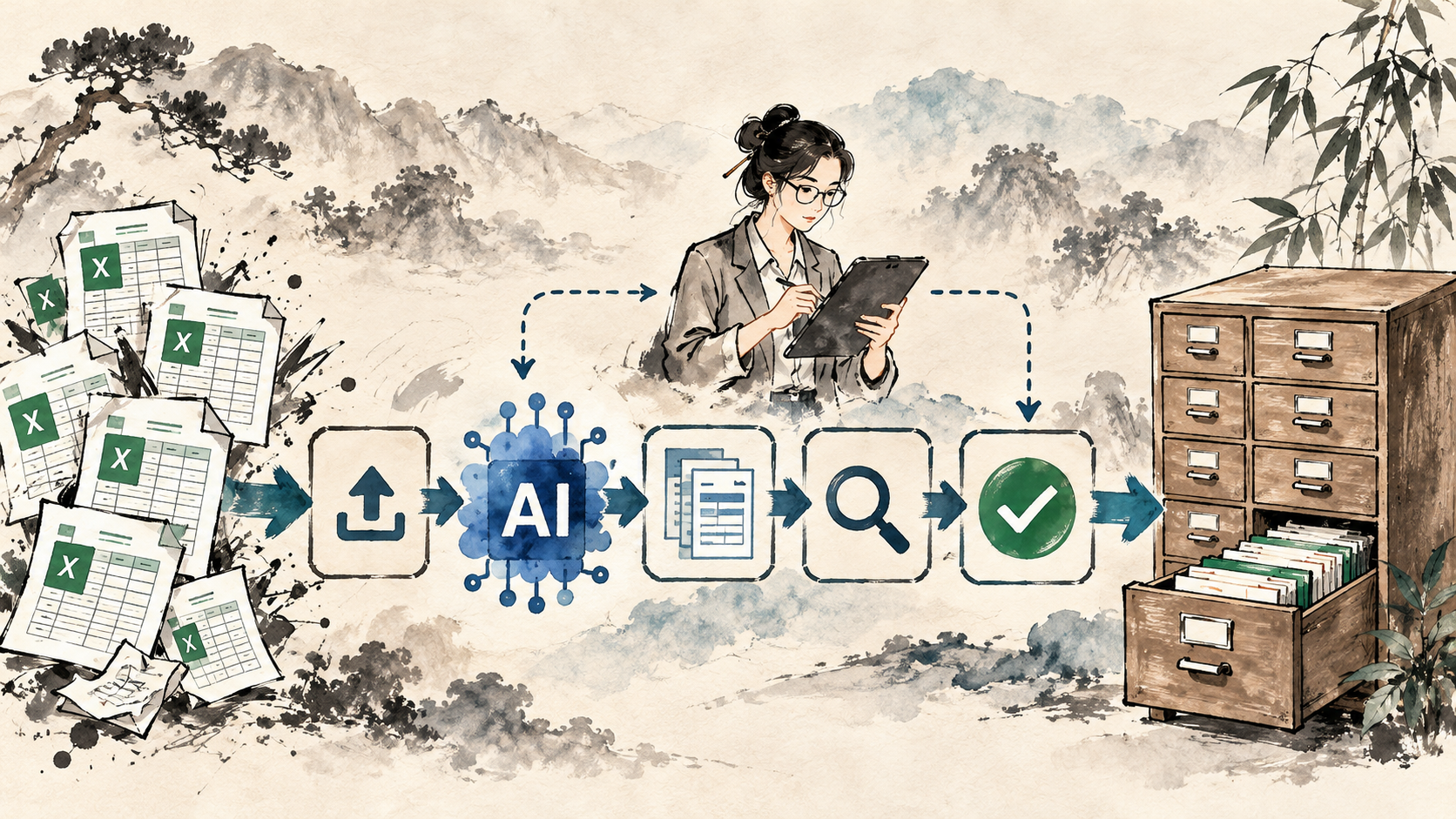
AI is no longer useful only when a developer gives it a repository and asks for the next feature. Reverse-engineering workflows can feed AI disassembly, traces, tests and binary behavior, then iteratively reconstruct source-level code.
In October 2026, Maurice Heumann described a project in which multiple AI agents helped reconstruct Call of Duty: Modern Warfare 2 (2009), described generically as a first-person shooter in the project's current public write-up, as C++. He reported that 99% of functions had been recovered in some form, with 83% matching the original compiled function bytes under the project's verification process [4, 7]. The developer also made an important admission: early AI-generated code was readable but often wrong. Progress accelerated only after the team introduced strict, machine-checkable validation.
The original goal included portability—to Linux, macOS or even browsers—but the team deferred those goals to focus on reproducing behavior [4]. That distinction matters: reconstruction is not the same as a completed WebAssembly port. Still, AI-assisted decompilation and cross-platform tooling are pulling previously separate activities closer together.
- Code generation becomes easier; objective verification becomes more valuable.
- Reconstructing behavior differs from recovering an author's exact original source.
- A functional prototype does not establish production quality, ownership or permission to redistribute.
3. Reinventing the product without the original code
In another example, the ArtCraft family of open-source creative applications is being built in Rust, with significant AI assistance. Projects such as VectorCraft describe themselves as independent, clean-room reinterpretations of established creative workflows and offer native as well as WebAssembly targets [5].
The interesting part isn't whether those apps already match Adobe Creative Cloud. They do not: independent hands-on reviews identify significant gaps in compatibility, stability and professional features [6]. The interesting part is the shrinking organizational threshold for attempting such a wide range of complex applications.
That difference is essential. Reimplementing an idea, workflow or behavior is not the same as acquiring proprietary source, nor does visual similarity make a new product equivalent.
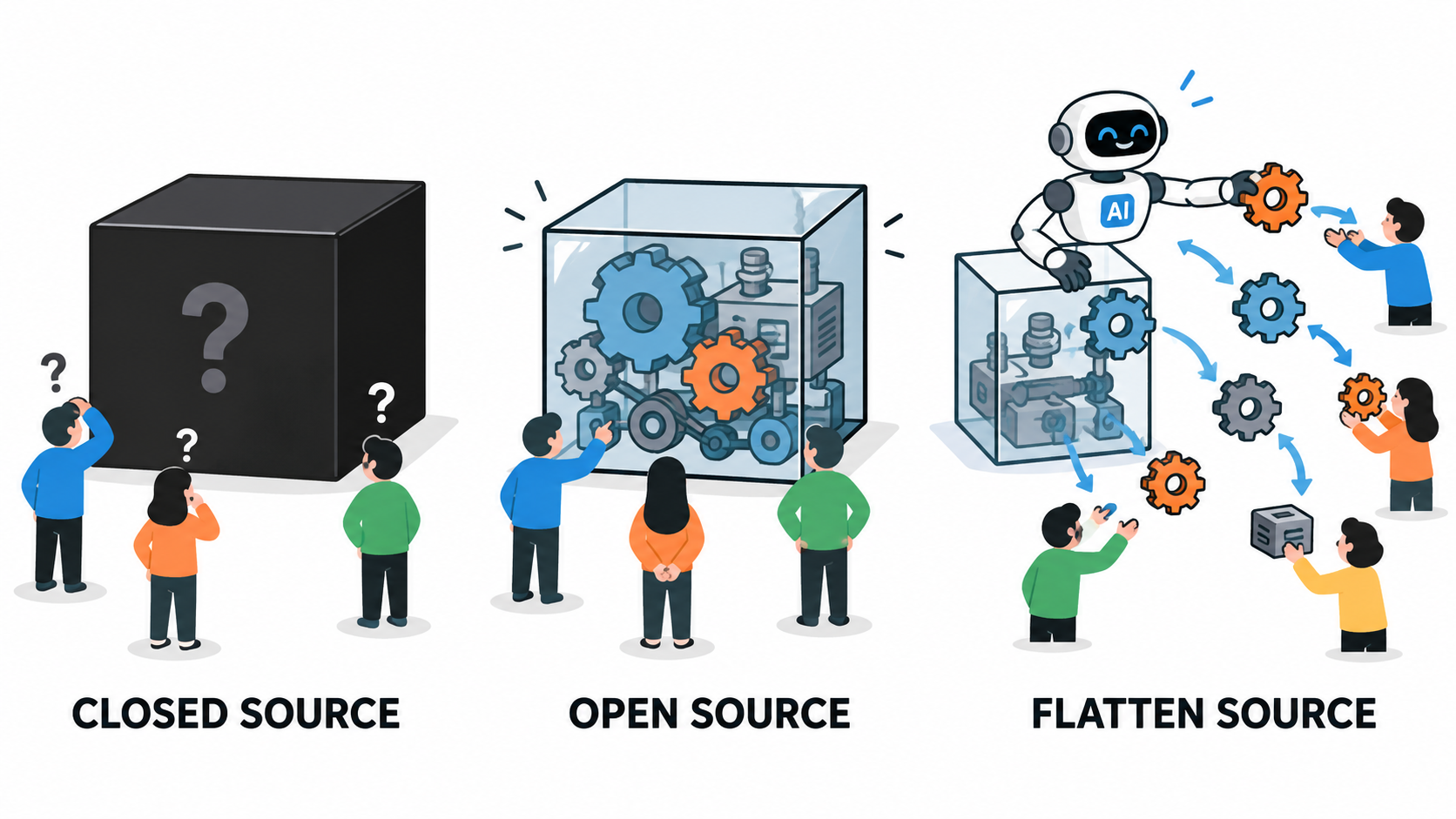
4. Closed → Open → Flatten: a useful mental model
CLOSED SOURCE: the vendor retains control of the source code, and customers primarily receive executable software or a hosted service. Understanding internals can be expensive and legally constrained.
OPEN SOURCE: licenses permit studying, modifying and redistributing source under specified conditions. Communities can collaborate and inspect implementation choices, but open-source does not mean there are no rules.
FLATTEN SOURCE: our proposed name for a third force—the decreasing cost of moving between a description of behavior, a running program and a newly written implementation. With AI, decompilers, specifications and evaluators, an outsider may increasingly produce a similar result without obtaining the original repository.
The word 'flatten' is a metaphor: it refers to a flatter knowledge and implementation barrier, not to a new licensing status or to the disappearance of copyright.
“When reproducing the behavior gets cheaper, access to the original source is no longer the only path to building something comparable.”
5. What this does—and doesn't—change
It changes how we think about competitive advantage. If a product's differentiation lives entirely in a reproducible workflow or a handful of common features, its technical lead may become shorter. Teams may compete more intensely on distribution, proprietary data, customer experience, reliability and the ability to ship improvements.
But the boundaries are not gone. Security tools can be used defensively or maliciously. Platform exploits work only under certain conditions. Unofficial drivers may require disabled protections. AI-generated reconstructions may be incorrect. Intellectual-property rights, contracts, trademarks and software licenses still apply.
In other words: the cost of engineering may decrease much faster than the cost of responsibility.
6. AI changes everything—especially the work after generation
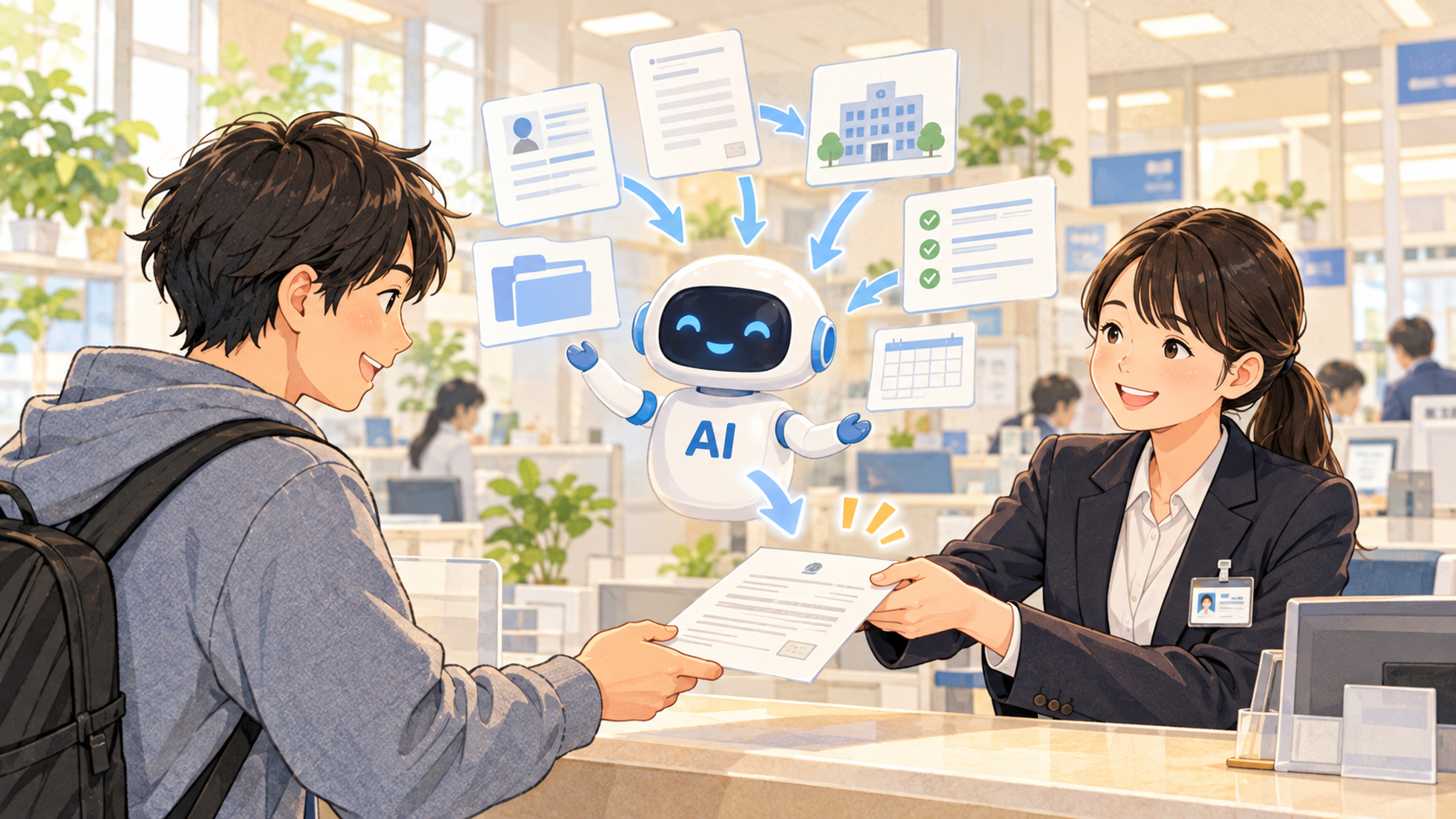
The story is not simply that code can be generated faster. It is that the distance between observing a system, understanding its behavior, and creating an alternative is narrowing. That will be exciting for interoperability and preservation, unsettling for some business models, and challenging for security and governance.
A final irony: the social post that inspired this analysis began with only a few bullet points. AI helped turn them into a fuller narrative. Someday, perhaps we will share only the bullets and let each reader's assistant tell the story in their own language and depth.
Maybe their AI will even tell it better. lol.
“AI CHANGES EVERYTHING. But correctness, trust and permission still matter.”
“Flatten Source” is an editorial framework, not a new technical standard or software license. Reconstructing behavior does not automatically confer a right to copy or redistribute software.
Sources & further reading
- [1]Chinese developer makes ARTEX AI agent closed-source after Korean bank hack Reuters · 2026-10-09
- [2]PS5 Jailbreaks Are Escalating at an Unprecedented Pace Push Square · 2026-10-06
- [3]New driver brings Nvidia GeForce RTX to Hackintosh Notebookcheck · 2026-10-09
- [4]500+ Billion Tokens Later: Letting AI Agents Decompile A First-Person Shooter Maurice Heumann (original project report) · 2026-10-09
- [5]VectorCraft: open-source creative tool written in Rust (repository) ArtCraft team / GitHub · 2026-10-15
- [6]One dev is recreating 7 Adobe apps in Rust for free — hands-on review TechRadar · 2026-10-11
- [7]AI agents used to reconstruct Call of Duty: Modern Warfare 2 source code Tom's Hardware · 2026-10-12